
GraphTalker
The AI Agent for your Context Graph
The AI Agent for your Context Graph
Your business knowledge lives in data, documents, relationships, rules, and years of operational history. Large language models can understand questions, but they do not inherently know how that information connects—or which enterprise facts and policies matter.
AllegroGraph and GraphTalker bring those capabilities together. AllegroGraph provides the enterprise knowledge graph and semantic reasoning foundation. GraphTalker is its agentic natural-language interface, helping users and AI applications explore connected knowledge, test questions against real data, and examine the evidence behind results.
With GraphTalker, organizations can also manage the repository-specific context that guides analysis, preserving terminology, ontology guidance, and proven query patterns as version-controlled, reusable knowledge.
Ask better questions. Discover connected evidence. Preserve enterprise expertise.Why Use GraphTalker?
Enterprise knowledge graphs contain valuable answers, but exploring them often requires specialized knowledge of data models and database query languages (SQL, SPARQL, etc.). GraphTalker helps make that investment accessible to more people without abandoning the structure and precision of the graph.
Ask questions in natural language. Let analysts and everyday users investigate connected enterprise data without writing complex database queries.
Go beyond document search. Follow relationships, examine events and provenance, and combine evidence across interconnected entities.
Inspect how results were produced. Review executed graph queries and supporting results instead of relying solely on an LLM-generated explanation.
Preserve knowledge that would otherwise be lost. Save useful analytical work and manage expert guidance for reuse across future investigations.
Extend AI applications. Access GraphTalker programmatically to bring knowledge-graph analysis into enterprise workflows and agent systems.
Learning Enterprise Memory Layer. Preserve and continuously improve organizational knowledge by incorporating expert feedback, validated insights, and proven query patterns into persistent, reusable context that makes future AI interactions more informed and reliable.From Knowledge Graph to Context Graph
What is a Context Graph? A Context Graph extends the knowledge graph with what an agent needs to understand the situation it is operating in. Think of the current operational state, goals and objectives, earlier decisions and actions, temporal relationships, causal dependencies, organizational policies and governance, provenance and data lineage, the interactions between people, systems, and agents, and long-term memory.
AllegroGraph provides the foundation. Its semantic graph database brings together entities, relationships, RDF data, documents, vectors, events, temporal information, provenance, and rules, with enterprise data-management and security capabilities. The graph retains the structure and meaning that conventional text-only retrieval can miss.
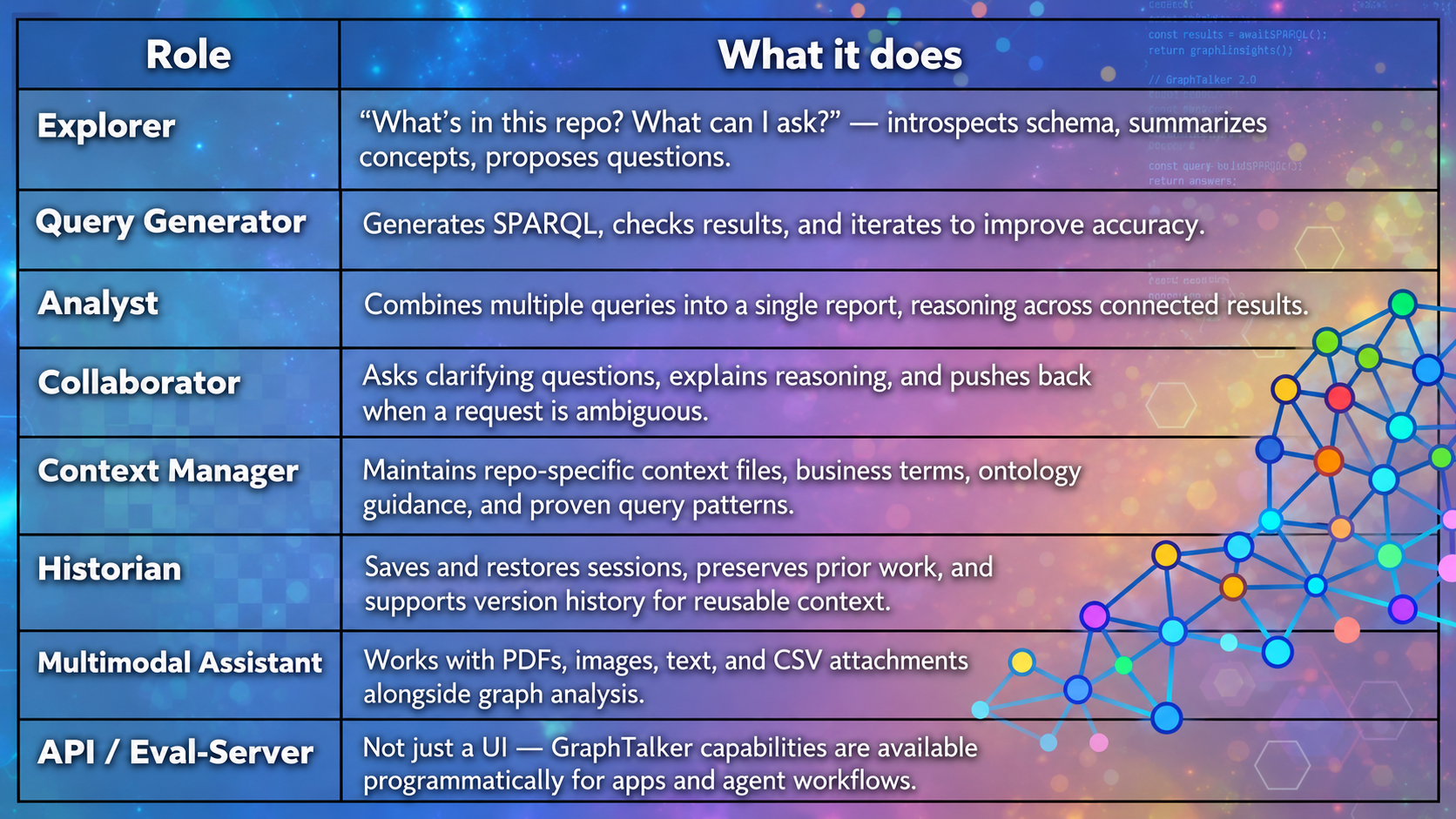
GraphTalker makes that foundation usable. It examines repository schemas, consults available guidance, generates and executes queries, interprets results, and revises its approach when needed. People can explore a graph conversationally, while developers can integrate the same capabilities into applications.
Together, they help turn connected knowledge into practical context for analysis and AI-assisted decisions. The graph stores and organizes enterprise knowledge; GraphTalker provides an agentic way to work with it.Enterprise Context Managment
Make Your Organization's Domain Expertise Reusable.
An AI agent may understand language but still misunderstand a company's abbreviations, ontology conventions, preferred measures, or valid query paths. That missing context can lead to unnecessary query attempts or misleading interpretations.
GraphTalker provides a Context Management System that lets teams maintain repository-specific context files. These files capture knowledge about an ontology, business terms, domain conventions, and useful query examples that GraphTalker can consult when analyzing the repository.
Instead of repeating instructions in individual sessions or relying on one specialist's memory, organizations can maintain a shared, inspectable source of guidance.
What You Can Manage
Repository-specific guidance: Document domain concepts, terminology, and proven query patterns.
Browser-based editing: Create, upload, edit, preview, download, and remove context files without server shell access.
Version control and rollback: Compare changes, inspect earlier versions, and restore previous content when necessary.
Knowledge portability: Export or import context-file collections, including their histories, between repositories or servers.
Human-guided improvement: Incorporate reviewed expert corrections and new analytical guidance into managed files for subsequent use.
Why this matters: The organization—not an isolated prompt—can maintain the instructions and expertise that help GraphTalker understand its data. Expert feedback can inform future work when people deliberately update the context files; responses are not automatically promoted into verified enterprise knowledge.How GraphTalker Goes Beyond RAG and GraphRAG
Beyond Retrieval: From Finding Information to Investigating Knowledge
Traditional RAG retrieves relevant documents or text passages to ground LLM responses. GraphRAG extends this approach by incorporating graph relationships to improve retrieval and provide richer context. GraphTalker goes further by enabling agents to actively explore, query, and reason over enterprise Knowledge Graphs, testing hypotheses and following relationships to uncover answers that retrieval alone may miss.
Beyond One-Shot Queries: Agentic Reasoning
Unlike basic natural language tools that generate a single query, GraphTalker examines schemas, applies enterprise context, generates and executes queries, evaluates results, and iteratively refines its approach. This enables more sophisticated investigations across complex enterprise data.
Beyond Answers: A Learning Enterprise Memory Layer
GraphTalker combines AllegroGraph's semantic relationships, symbolic reasoning, and provenance with persistent, enterprise-managed context. Domain experts can preserve validated insights, corrections, and successful query patterns as reusable knowledge, helping improve future interactions without relying on isolated prompts or temporary retrieval context.
The difference: RAG retrieves information. GraphRAG enriches retrieval with relationships. GraphTalker enables agentic investigation grounded in a persistent Context Graph—connecting knowledge, reasoning, and reusable enterprise memory to deliver more explainable, governed, and auditable AI.Why GraphTalker is key to your Knowledge Graph centric application
A Learning System That Gets Smarter
GraphTalker turns expert feedback, successful queries, and discoveries into reusable enterprise knowledge—improving future interactions for everyone.
Explore Knowledge, Not Just Data
GraphTalker understands schemas, follows relationships, tests hypotheses, and uncovers insights without requiring users to master complex queries.
Persistent Enterprise Memory
Sessions, queries, and version-controlled context preserve institutional knowledge, allowing AI agents to build on previous work rather than start from scratch.
Beyond Retrieval to Reasoning
GraphTalker combines agentic AI with Knowledge Graphs and symbolic reasoning to deliver context-rich, explainable answers grounded in enterprise knowledge.
Neuro-Symbolic AI in Production Form
GraphTalker is the practical embodiment of the Neuro-Symbolic vision Franz has championed for many years. Pure language models are fluent but ungrounded — they hallucinate facts, invent schema, and produce queries that look right and return nothing. Pure symbolic systems are precise but brittle, demanding hand-written queries from people who understand the data model. GraphTalker fuses the two.
The neural side — a large language model — contributes natural-language understanding, hypothesis generation, and the ability to interpret error messages and refine its approach. The symbolic side — RDF, OWL, SHACL, SPARQL, and the AllegroGraph engine — contributes formal schema, deterministic execution, and verifiable retrieval against ground-truth data. The agent loop binds them: the model proposes, the graph validates, the system iterates until the answer is correct.
Every answer GraphTalker produces is grounded in a real query against real data. The user can inspect the SPARQL, the path through the graph, and the results. There is no opaque generation step, no statistical approximation of an answer. This is what Neuro-Symbolic AI looks like when it is engineered for the enterprise.Who Should Use GraphTalker
A knowledge graph is only as valuable as the people who can use it. GraphTalker was designed to broaden that audience without diluting the rigor of the underlying graph.
Business analysts and domain experts ask questions in the language of the business and receive answers backed by traceable queries. They no longer wait on a SPARQL specialist for ad-hoc analysis, and they can save successful questions to a shared library for the next person to reuse.
Data architects and knowledge engineers see how their ontology is actually used. Every question, every successful query, and every failed attempt becomes feedback on schema design. The query library becomes institutional memory — a record of which patterns work and which gaps remain.
AI engineers and application developers embed GraphTalker into larger systems through its Python client and HTTP evaluation server. Stateful sessions, conversation save and restore, and programmatic access make GraphTalker a building block for higher-order agents, dashboards, and workflows — not just a chat window.
Data and analytics leaders (CDO, CIO, CTO) see the return on their knowledge-graph investment. The graph stops being a specialist asset and becomes the conversational interface to enterprise data. Adoption is measurable, governance is preserved, and ad-hoc questions become reusable, scheduled pipelines.
Governance, compliance, and audit teams get full transparency. Every query GraphTalker generates is visible, every tool call is logged, and every answer can be traced to the underlying triples. There is no black box between the question and the data.Proven across domains
GraphTalker has been validated across enterprise HR analytics, product catalogs, biomedical knowledge graphs, and geospatial data. Without retraining or domain-specific tuning, it adapts by exploring schema and data at query time, giving organizations a practical way to scale natural-language access across multiple domains.Additional GraphTalker Capabilities
Saved Queries, Visualizations, and Sessions
GraphTalker's workspace organizes natural-language interactions, context files, queries, and session history. GraphTalker's metagraph stores saved queries, related visualizations, and preserved sessions so that useful analytical work can be revisited rather than repeated from scratch.
Support for Large Schemas
Preprocessed schema overviews help GraphTalker navigate repositories with large and complex data models, reducing the burden of repeatedly discovering how the graph is organized.
Documents and Images added to Queries
Users can attach PDFs, images, text files, and CSV files to a query, allowing the supplied material to inform a question alongside graph analysis. Attachments provide input to the current interaction; uploaded files can be persisted in the knowledge graph.
APIs for Enterprise Applications
GraphTalker is not limited to its browser interface. Its HTTP-based interface and Python client can support integration into custom applications, dashboards, and broader AI agent workflows.
Overview Video to learn more about GraphTalker.
Read the Technical Documentation