
- 10 April, 2026



Beyond Graphify: Why the Enterprise Needs More Than a Folder-to-Graph Tool
There has been a lot of excitement lately around ideas like the “LLM wiki” and tools such as Graphify.
The appeal is easy to understand. Instead of forcing an LLM to repeatedly scan raw files, these approaches create a structured layer of information first. That layer becomes a kind of memory for the AI system. It helps reduce token waste, improves retrieval, and gives the model something more durable than a single prompt window.
That is a smart direction.
But in the enterprise, it is only part of the story.
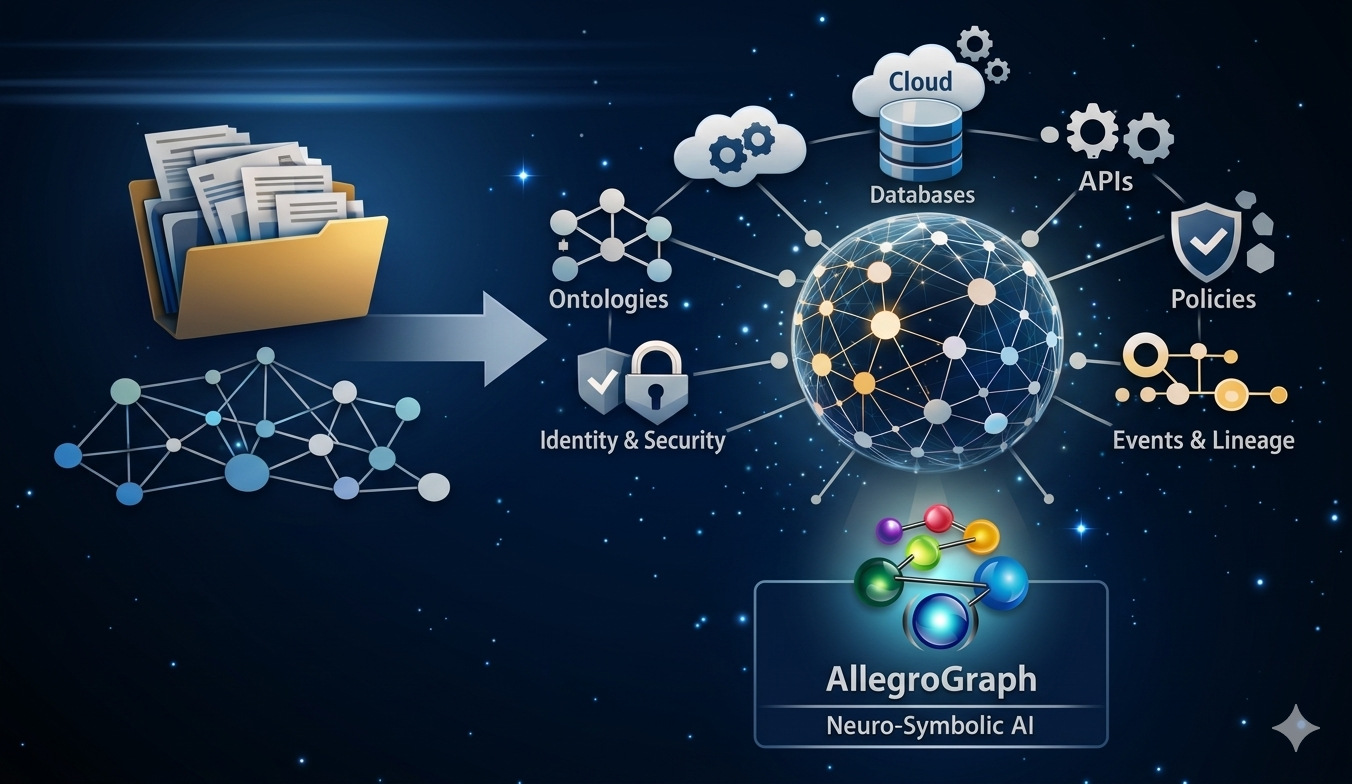
The real challenge is not simply turning folders into a graph. The real challenge is creating a semantic foundation that connects enterprise data, documents, rules, and processes in a way that AI systems can use reliably. That is where a true knowledge graph becomes essential, and that is where AllegroGraph plays a much larger role.
The enterprise problem is bigger than document memory
Graphify-style approaches are useful because they expose a real weakness in current AI architectures: too much enterprise AI still depends on repeatedly parsing raw content and rediscovering structure that should already be represented explicitly.
But most enterprises are not struggling only with document retrieval.
They are dealing with structured and unstructured data spread across relational databases, JSON stores, APIs, file systems, event streams, taxonomies, ontologies, policies, and line-of-business applications. They are dealing with different names for the same entities, different systems of record, different security requirements, and different business rules that all have to work together.
In that environment, building a graph from documents is helpful, but it is not enough.
The enterprise needs a semantic layer that can connect people, systems, data, documents, and meaning across the organization.
A knowledge graph is not just memory. It is enterprise structure.
A simple document graph can help an assistant navigate content.
An enterprise knowledge graph does much more. It provides a shared model of the business. It captures entities, relationships, constraints, and semantics across systems that were never designed to interoperate cleanly. It gives AI a framework not just for retrieval, but for context, validation, traceability, and reasoning.
That distinction is important.
A folder-to-graph approach may help answer questions about a corpus. A knowledge graph platform helps answer enterprise questions such as:
- What customer, patient, supplier, or asset is this really referring to across different systems?
- What evidence supports this answer or recommendation?
- What policy, ontology, or business rule should constrain the result?
- What changed, who changed it, and what downstream effects follow?
- What information can an agent access, and under what permissions?
- How do I combine structured data, documents, and semantic relationships in a governed workflow?
These are not just retrieval problems. They are enterprise meaning problems.
Why Neuro-Symbolic AI is critical
This is also where neuro-symbolic AI becomes essential.
Neural models are excellent at language, summarization, extraction, and pattern recognition across messy data. But on their own, they often lack consistency, traceability, and respect for explicit business rules. They are powerful, but they are probabilistic. In enterprise settings, that creates limits.
Symbolic systems bring the complementary strengths enterprises need: explicit semantics, logic, rules, constraints, provenance, and the ability to validate outputs against known facts and policies.
A knowledge graph is the ideal foundation for this kind of neuro-symbolic architecture. It gives AI a structured representation of entities, relationships, classifications, and constraints that can anchor model outputs in enterprise reality. Instead of relying only on statistical prediction, the system can combine learned intelligence with symbolic reasoning and validation.
That matters because enterprise AI cannot just sound good. It has to be dependable.
As organizations move from copilots to agents, this becomes even more important. Agents are expected to do more than summarize information. They must navigate tools, coordinate tasks, make decisions, and interact with operational systems. In those environments, “probably right” is often not good enough. Enterprises need AI that can combine language fluency with formal knowledge, policy awareness, and explainable reasoning.
That is the promise of neuro-symbolic AI, and it is one of the strongest reasons knowledge graphs matter.
Why this matters for AI agents
Much of the current AI discussion still assumes a model sitting on top of documents. But agentic systems require more than access to content. They require context that persists across tasks and systems.
Without a semantic backbone, agents are left to improvise across fragmented schemas, inconsistent terminology, and disconnected data sources. They may still produce useful outputs, but they do so without a dependable system of record for meaning.
A knowledge graph changes that.
It gives agents a structured environment in which they can discover what exists, understand how things are related, navigate business context, and ground their actions in governed enterprise knowledge. It can also provide provenance, memory, and constraints, all of which become more important as agents gain autonomy.
In that sense, a knowledge graph is not just a better retrieval layer. It is a foundation for trustworthy agent behavior.
Why AllegroGraph matters here
At Franz, we see the opportunity as much larger than converting files into a graph for AI consumption.
AllegroGraph is built for organizations that need a knowledge graph to serve as enterprise infrastructure. That means supporting not just graph storage, but the broader requirements of serious enterprise AI: semantic modeling, reasoning, provenance, security, integration across heterogeneous data sources, and support for neuro-symbolic workflows that connect vectors, documents, and symbolic knowledge.
The point is not merely to help an LLM remember more efficiently.
The point is to help the enterprise represent meaning in a form that humans, machines, and AI agents can use consistently, transparently, and at scale.
That is a very different ambition from building a graph-shaped index over documents.
The future is not just smarter retrieval
The growing interest in LLM wiki and Graphify-style approaches is valuable because it signals an important shift. The market is recognizing that raw documents plus prompting are not enough. AI needs structure. It needs memory. It needs context that persists beyond a single interaction.
We agree with that direction.
But in the enterprise, the answer cannot stop at turning folders into a graph.
The real value comes when a knowledge graph becomes the connective tissue of the enterprise itself — linking data, documents, rules, ontologies, agents, and governance into a durable semantic system. And when that foundation is paired with neuro-symbolic AI, organizations gain something even more important than better retrieval: they gain a path to more trustworthy, explainable, and operationally useful AI.
That is the bigger opportunity.
And that is why AllegroGraph matters.
Related articles
Gary Marcus, Claude Code, and Why Neuro-Symbolic AI Needs Knowledge Graphs
- By Franz Inc.
- April 15, 2026
Gartner Is Sending a Clear Signal: Semantics are Essential in the AI Enterprise Infrastructure
- By Franz Inc.
- April 3, 2026