
- 15 April, 2026



Gary Marcus, Claude Code, and Why Neuro-Symbolic AI Needs Knowledge Graphs
The biggest advances in AI are no longer coming from standalone LLMs. They are coming from hybrid systems, and that is exactly where AllegroGraph fits.
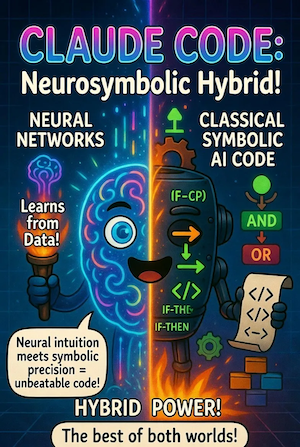
Gary Marcus’s latest essay makes a point the enterprise market can no longer ignore: the next meaningful phase of AI is not about bigger standalone language models. It is about systems that combine LLMs with tools, structure, and symbolic methods. In Marcus’s words, Claude Code may be “the single biggest advance in AI since the LLM” precisely because it is “not a pure LLM.” He argues that this is further evidence that AI is moving in a neurosymbolic direction.
“The single biggest advance in AI since the LLM.”
“Not a pure LLM.”
That observation matters well beyond coding assistants.
Enterprise leaders are learning that LLMs alone are not enough for serious work. If you want AI to operate across real business systems, make sense of complex relationships, respect governance, trace sources, and produce results that can be checked and trusted, you need more than text prediction. You need structure. You need reasoning. You need a semantic foundation.
That is where AllegroGraph comes in.
AllegroGraph is built for this moment because it aligns with the architecture the market is now moving toward: neuro-symbolic AI grounded in a standards-based semantic knowledge graph. Instead of treating enterprise data as disconnected text to be embedded and searched, AllegroGraph models meaning directly, including entities, relationships, rules, provenance, and context, so AI systems can work from a governed understanding of the enterprise.
“Further evidence for neurosymbolic AI.”
Marcus’s broader point is that some of the most important advances in AI are already hybrid. He argues that real progress is increasingly coming from systems that blend neural methods with more classical AI techniques, structured processes, and explicit control. Whether one agrees with every detail of his framing, the larger trend is hard to miss: the market is shifting toward AI systems that can act through tools and operate within structured environments rather than relying on language generation alone.
Anthropic’s own materials point in the same direction. Claude Code is described as an “agentic coding tool” that reads a codebase, edits files, runs commands, and integrates with development tools. Anthropic’s tool-use documentation likewise explains how Claude can decide when to call tools and orchestrate actions through an agentic loop. In other words, its practical power comes from combining a model with tools, execution, and structure, not from next-token prediction alone.
For the enterprise, that lesson is even more important.
The future is not another isolated AI layer sitting on top of disconnected systems. The future is an AI-ready semantic layer built on a semantic knowledge graph, one that is standards-based, explainable, interoperable, and resistant to proprietary lock-in. That semantic layer gives AI agents and applications the context they need to retrieve the right facts, follow relationships, apply logic, preserve provenance, and produce outputs that can be trusted.
This is the real power of AllegroGraph.
AllegroGraph brings together graph, vector, and document capabilities in a single platform designed for governed, explainable AI. It gives enterprises a durable semantic backbone for intelligent applications, accountable agents, and grounded decision support. That is the difference between AI that sounds good and AI that can actually operate in production.
The market is shifting from pure prediction to grounded intelligence.
The winners will not be the organizations with the biggest models alone. They will be the ones with the best semantic foundation.
Gary Marcus is reading that shift through the success of Claude Code. We see the same shift through enterprise requirements. Different vantage point, same conclusion: the next wave of AI will be hybrid. It will combine language models with symbolic structure. And it will depend on knowledge graphs to provide meaning, control, and trust.
Get started with AllegroGraph today – https://allegrograph.cloud/signin.
Related articles

Forrester Defines the Context Layer: Building the Living Context Graph for Agentic AI
- By Franz Inc.
- September 11, 2026

Adaptive Learning and Enterprise Personalization – Dr. Aasman’s Perspective
- By Franz Inc.
- September 10, 2026