
- 28 October, 2026



Netflix’s Ontology-Driven AI Architecture Validates the Need for Context Graph
Why Netflix’s embrace of W3C standards, Knowledge Graphs, and persistent enterprise memory reinforces the foundation of trusted Agentic AI.
When one of the world’s most sophisticated technology companies embraces ontologies, Knowledge Graphs, and W3C semantic standards to support AI agents, the enterprise AI industry should take notice.
In a recent Netflix Technology Blog article, “Ontology-Driven Observability: Building an End-to-End Knowledge Graph at Netflix Scale,” Netflix engineers describe an ambitious architecture for connecting operational data, preserving human expertise, and enabling AI agents to reason across complex systems.
The implications extend well beyond observability. Netflix’s experience demonstrates why enterprise AI requires more than large language models, vector search, and disconnected data sources. It needs a shared semantic foundation that captures relationships, context, business rules, and institutional knowledge.
These principles are central to the Neuro-Symbolic AI architecture Franz has advanced through AllegroGraph, GraphTalker, and its vision for persistent, learning Context Graphs.
The Real AI Challenge: Data Without Context
Netflix operates at an extraordinary scale, processing more than two billion requests daily and handling tens of millions of real-time logging events every second.
When something goes wrong, engineers must investigate signals from numerous independent systems: application telemetry, incident management, deployments, infrastructure, and human conversations. The challenge isn’t necessarily a lack of data. It’s that critical relationships between systems, events, and decisions remain fragmented.
Netflix describes an example investigation taking approximately four hours, much of which is spent reconstructing relationships that already exist across its operational systems. This is a familiar enterprise problem. Organizations have invested heavily in collecting information, but the meaning of that information—and how it relates to other information—often remains locked inside applications, documents, and individual employees’ knowledge.
Adding another AI chatbot doesn’t solve this problem. Even powerful language models cannot reliably reconstruct enterprise-specific relationships without appropriate context. Netflix’s solution starts with an ontology.
Netflix Embraces W3C Standards for Enterprise Knowledge
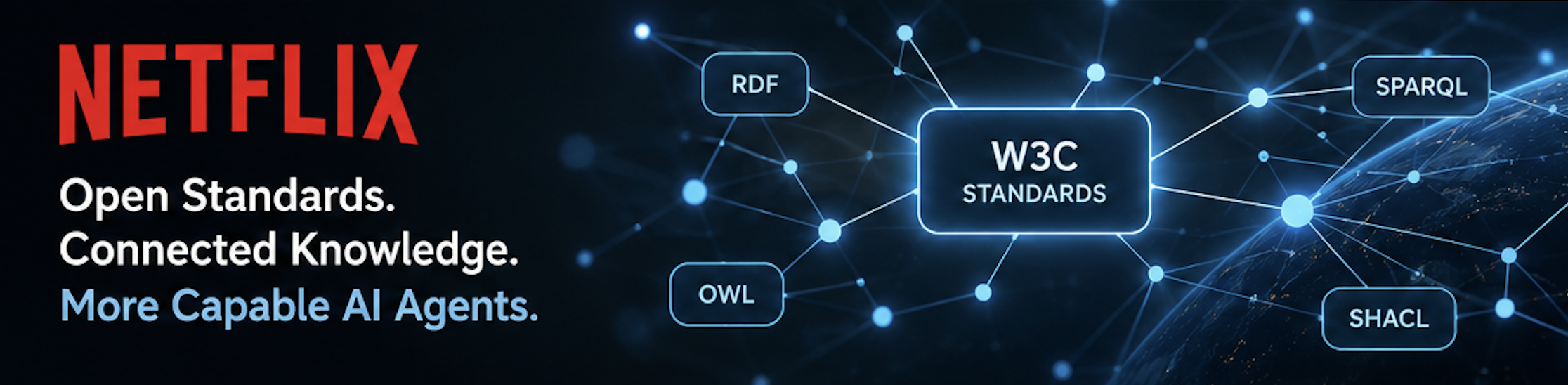
One of the most significant aspects of Netflix’s architecture is its explicit adoption of the World Wide Web Consortium (W3C) semantic technology stack.
Netflix uses:
- RDF (Resource Description Framework) to represent entities and relationships as connected facts.
- OWL (Web Ontology Language) to define shared concepts and their meaning.
- SHACL (Shapes Constraint Language) to validate data against structural and semantic constraints.
- SPARQL to query information across connected relationships.
These are the same foundational technologies supported by AllegroGraph.
Netflix emphasizes the portability of standards-based models across different graph database implementations. This is a critical architectural consideration for enterprises seeking interoperability and freedom from proprietary data-model lock-in.
For Franz, the significance is substantial.
AllegroGraph has long been built around RDF, ontologies, SPARQL, and semantic reasoning. Its architecture combines these standards with high-performance graph storage, vector search, document management, temporal information, and symbolic reasoning.
Netflix’s approach provides an important real-world example of why these standards remain relevant in the age of generative and agentic AI.
The future of enterprise AI is not about replacing semantic technologies with LLMs. It’s about combining them.
Ontologies Give AI Agents a Shared Understanding
Perhaps the most important insight from Netflix’s engineering work is the role of ontologies in coordinating intelligent agents.
Netflix describes an internal agentic system called AutoRCA that uses specialized AI agents to investigate operational problems. Different agents analyze telemetry, logs, traces, and other evidence, but they communicate through a shared ontology and Knowledge Graph.
Instead of each agent independently interpreting what an application, service, deployment, or incident means, they operate against a common semantic model.
This architectural choice addresses a fundamental weakness of many agentic AI systems: language models can generate convincing explanations, but without consistent definitions and trusted relationships, they can misinterpret enterprise data.
An ontology establishes meaning. A Knowledge Graph connects the facts. Symbolic reasoning and validation help enforce constraints. AI agents use that foundation to investigate and explain.
This is also the philosophy behind GraphTalker, Franz’s agentic natural-language interface to AllegroGraph. GraphTalker doesn’t simply convert a natural-language question into a database query. It examines the Knowledge Graph’s schema, consults examples and contextual guidance, generates and executes SPARQL queries, evaluates results, and refines its approach.
The result is a Neuro-Symbolic AI process in which the flexibility of an LLM is combined with the precision of a standards-based Knowledge Graph. Users can ask complex questions in natural language while retaining access to the underlying queries and supporting evidence.
From Knowledge Graphs to Persistent Enterprise Memory
“…the ontology gradually stops being a schema and starts being a memory.”
— Netflix Technology Blog
This observation from Netflix may be the most consequential of all.
Netflix describes a continuous knowledge-enrichment process in which operational observations, inferred relationships, incident investigations, and human insights become reusable knowledge. Instead of treating every incident as an isolated event, the system can preserve information about what happened, what investigators discovered, which hypotheses were considered, and which actions worked. Over time, that accumulated knowledge can improve future investigations.
This is the essential idea behind the Context Graph: a persistent enterprise memory layer that extends traditional Knowledge Graphs with operational history, decisions, actions, evidence, and relationships. Traditional Knowledge Graphs organize what an enterprise knows.
Context Graphs extend this foundation to capture how knowledge relates to evolving situations, why decisions were made, which evidence supported them, and what happened afterward. For AI agents, this distinction is crucial. An agent should not have to rediscover the same organizational knowledge every time it begins a new task.
GraphTalker 2.0: Making Enterprise Context Reusable
The introduction of AllegroGraph 9.1 with GraphTalker 2.0 advances this vision by enabling organizations to preserve and manage the knowledge that guides AI interactions. GraphTalker’s Enterprise Context Management capabilities allow teams to maintain version-controlled, repository-specific knowledge about ontologies, business terminology, domain conventions, and proven query patterns.
Human experts can contribute corrections, validated insights, and guidance that can be deliberately preserved for future analysis. This creates an important feedback loop between human expertise and AI-assisted investigation. Rather than relying exclusively on information embedded in model weights or temporary chat sessions, organizations can curate persistent, inspectable context that improves subsequent interactions.
GraphTalker 2.0 also extends analysis to documents and images supplied with individual requests, allowing users to examine additional evidence alongside their Knowledge Graph. The underlying objective closely aligns with the lesson emerging from Netflix’s work: organizational knowledge becomes more valuable when it is connected, governed, preserved, and reusable by both people and AI agents.
Netflix and Franz have developed different implementations for different use cases. But both approaches recognize the importance of combining AI capabilities with explicit semantic models and persistent knowledge.
Why This Matters Beyond Observability
Netflix’s implementation focuses on operational observability, incident investigation, and eventually automated remediation. But the underlying architecture applies to virtually any industry where AI agents must reason across complex information and business processes.
In healthcare, Context Graphs can connect patients, clinical events, treatments, medical evidence, and historical decisions. In financial services, they can link transactions, counterparties, regulations, risk assessments, and compliance actions. In manufacturing and supply chains, they can connect equipment, suppliers, dependencies, operational events, and the decisions that affect production. Across these industries, the challenge is remarkably similar: AI systems must understand not only individual facts but also their relationships, meaning, history, and governing constraints.
AllegroGraph provides a standards-based semantic foundation for these applications, combining Knowledge Graphs, vector search, rules, reasoning, and enterprise data management. GraphTalker adds an agentic interface that makes this knowledge accessible through natural language and reusable analytical workflows.
Together, they provide a practical foundation for building Context Graphs that support more explainable, context-aware enterprise AI.
The Bigger Picture: The Future of Agentic AI Is Neuro-Symbolic
Netflix’s architecture reinforces a broader shift taking place across enterprise AI. The initial excitement around generative AI focused on what language models could produce. The next phase increasingly depends on what AI agents can reliably understand, investigate, remember, and explain. That requires connecting neural AI capabilities with explicit knowledge representation, formal semantics, deterministic querying, validation, and symbolic reasoning. It also requires preserving the organizational expertise that makes enterprise data meaningful.
Netflix’s decision to build its architecture around ontologies and W3C standards is a powerful demonstration of this direction.
For Franz, it reinforces a strategy pursued through years of innovation in semantic Knowledge Graphs and now extended through GraphTalker and Context Graph technologies. The goal isn’t simply to give AI agents more data. It’s to give them the meaning, context, and persistent memory needed to use that data intelligently.
And that may be the most important architectural foundation for the next generation of trusted enterprise AI.
Learn More
Explore AllegroGraph and GraphTalker to learn how Franz combines W3C standards, Knowledge Graphs, and Neuro-Symbolic AI to build persistent enterprise context for intelligent agents.
Original reference: Netflix Technology Blog, October 16, 2026 — Ontology-Driven Observability: Building an End-to-End Knowledge Graph at Netflix Scale
Related articles
AllegroGraph 9.1 Introduces GraphTalker 2.0: Building Persistent Enterprise Memory for AI Agents
- By Franz Inc.
- October 16, 2026

Forrester Defines the Context Layer: Building the Living Context Graph for Agentic AI
- By Franz Inc.
- September 11, 2026